
North Carolina Arrest History
An arrest in North Carolina creates related records, not one universal file. The arresting officer makes an incident or arrest report. If booking follows, a county detention center assigns a booking number and records intake time, fingerprints, a photograph, charges, bond information, court dates, and custody status. A magistrate or court then creates process and release records. Each custodian answers a different question, so a booking entry cannot stand in for the later court judgment.
For charges covered by state law, the arresting agency sends fingerprints to the NC SBI Criminal Information and Identification Section. That fingerprint transaction starts an arrest segment in the Computerized Criminal History file. Court disposition data and later correctional data arrive as separate segments. An NC SBI history can therefore differ from a jail roster or court file when fingerprints were not submitted, a disposition has not matched, or the event remains only in a local system.
Who Holds North Carolina Arrest Reports
The creating agency controls the first report. County sheriffs handle arrests within their authority, run detention centers, and keep jail booking data. Municipal police departments maintain their own city arrest and incident records, while the county jail may hold the related booking. State Highway Patrol records arise from statewide traffic enforcement and collisions. Campus, company, and special police retain records within their statutory jurisdictions. SBI investigators may create investigative files, but CIIS performs the distinct repository role.
North Carolina Public Records Law does not turn the complete investigative file into an open file. G.S. 132-1.4 permits access to specified facts, including the time, place, and nature of an alleged violation, basic identifying facts about a person arrested or charged, the alleged offense, and certain arrest circumstances. Witness interviews, informant identities, surveillance, evidence analysis, medical details, and officer work product may remain protected. A focused request for named records and statute-listed facts is more useful than a demand for everything.
Note: Request the arrest record from its creating agency, even when the related booking occurred at a different county office.
How North Carolina Arrests Reach the Record
North Carolina law requires arrest fingerprints for felonies and specified misdemeanors and directs agencies to forward them to SBI. Live Scan or a mailed fingerprint card connects the charge to a biometric identity, which helps SBI associate aliases and future entries with the correct person. The county court later supplies the final disposition. Under G.S. 15A-1382, covered dispositions generally must reach SBI within 60 days when the person was fingerprinted, and felony guilty dispositions follow the same reporting period.
Data flow: Arrest › Booking › Fingerprint Submission › NC SBI Repository Entry
The chain can break. A citation without qualifying fingerprints may never form an SBI arrest segment. A local booking can appear before the electronic fingerprint submission clears. Charge identifiers may fail to match a later court outcome. SBI’s Right to Review form describes linked dispositions as available, not guaranteed. For that reason, compare the fingerprint history with the case file from the county Clerk of Superior Court.
No Single North Carolina Arrest Database
A statewide name search does not show every North Carolina arrest. County jail rosters supply the freshest booking and release facts, but their vendors, fields, and retention periods vary. The North Carolina eCourts Portal adds public case events after a charge enters the court system. NC SBI offers a fingerprint-based personal Right to Review by mail, not a public pay-per-name portal. NCDAC appears only when state prison or community supervision becomes part of the record.
Booking photographs follow the same custodian-based rule. North Carolina has no single public state mugshot database. Release depends on the holding agency, G.S. 132-1.4, and restrictions for juveniles, victims, active investigations, or sensitive images. Images from private mugshot aggregators are not a sound substitute for an official record and are not republished here.
The first appearance also belongs to the court side of the system. A judicial official confirms identity, addresses the charge, and sets release conditions within the law. Common entries may reflect a written promise, unsecured conditions, secured or cash terms, a custody hold, or no release. The order is the controlling source. A jail roster may shorten the wording or lag behind a new order, so confirm bond and the next court date through the Clerk of Superior Court. Returned arrest warrants generally become public unless sealed, while active unreturned process can remain restricted. A missing Portal result is therefore not proof that no warrant or arrest process exists.
Note: A county roster, eCourts summary, and SBI review can update on different schedules after the same North Carolina arrest.
Looking Up Arrests in North Carolina
Begin with the event’s location and age. Recent North Carolina arrest records are most likely to be with the sheriff, detention center, or arresting police department. A case summary may follow in eCourts. Older fingerprint-supported events may appear in the subject’s NC SBI review. Use each source for the facts it actually owns.
- Identify the county and likely arresting agency. Use the directory of all 100 North Carolina counties to reach the proper local criminal-record source.
- Check the county detention roster or call the booking desk. Ask the agency records unit for releasable arrest facts using the date, place, or event number.
- Search the North Carolina eCourts Portal for a public criminal case, then verify the charge, bond order, and outcome with the filing county clerk.
- For your own statewide fingerprint-supported history, request the $14 NC SBI Right to Review. Compare its entries with county documents.
An arrest entry does not reveal guilt. Read each charge-level disposition. If the online case is missing or the matter is old, a courthouse public terminal provides a free statewide noncertified search, while the county clerk holds copies and archived files.
County Booking Versus NCDAC Custody
County detention centers hold most people awaiting trial and some people serving local sentences. The sheriff or county controls booking, phone, visitation, release, and roster practices. By contrast, the North Carolina Department of Adult Correction holds sentenced state prisoners and supervises probation, parole, and post-release cases. Its Offender Public Information Search includes current and historical state data back to 1972, but excludes county jails.
| Source | Best For | Key Limit |
|---|---|---|
| County jail | Current booking, charges, bond, release | No statewide roster |
| NCDAC search | State prisoners and supervisees | No county-jail records |
| NC SAVAN/VINELink | Custody status alerts | Not a full criminal history |
A release entry can mean bond, court order, sentence completion, hospital placement, or transfer to another jail, NCDAC, federal custody, or another jurisdiction. Read the destination and court record before drawing a conclusion from a vanished jail listing.
NC SAVAN and VINELink can send phone, email, text, or TTY notices when custody status changes for participating county inmates, state prisoners, supervisees, and registered offenders. Alerts help track movement, but they do not reproduce an arrest report, list every court event, or explain why a release occurred. Use the notice as a prompt to check the jail, NCDAC, or court custodian that made the change.
Note: A missing jail listing may reflect transfer or release, so check the court order and destination before assuming the outcome.
Inside a North Carolina Arrest Record
Fields vary by custodian, but North Carolina arrest and booking records often combine identity, event, charge, and custody data. Health screening and other intake safety details are not ordinary public fields. Charges listed at booking remain allegations and may later be amended, dismissed, or resolved on different terms.
| Name and Identifiers | Name, aliases, date of birth, physical descriptors, and agency identifiers where public. |
|---|---|
| Arrest Event | Event number, arrest date, time, location, agency, and officer. |
| Alleged Charges | Offense description, statute, class, process type, and warrant or order number where public. |
| Booking Details | Booking number and time, fingerprints, photograph, and detention location. |
| Release Conditions | Bond type or amount, custody hold, release status, and first appearance information. |
| Court Link | Case number, first court date, and filing county when assigned. |
An empty bond field does not prove release or no release. The judicial order controls. Likewise, a case status marked disposed says only that the court completed the matter; the charge-level result explains whether it ended in conviction, dismissal, acquittal, or another outcome.
Reading North Carolina Arrest Statistics
The NC Justice Data Portal describes its NIBRS methods and coverage. Its dashboards refresh quarterly, while annual data is added the following July. Not every agency reports in every year, and agencies with fewer than six reporting months may be excluded. Always inspect the Reporting Agencies view before comparing places.
The portal helps place arrest data in context, but offense counts, incidents, and people are not interchangeable. Group A dashboards count offenses within incidents, while Group B supplies arrest-only data. A rate also needs its stated population denominator.
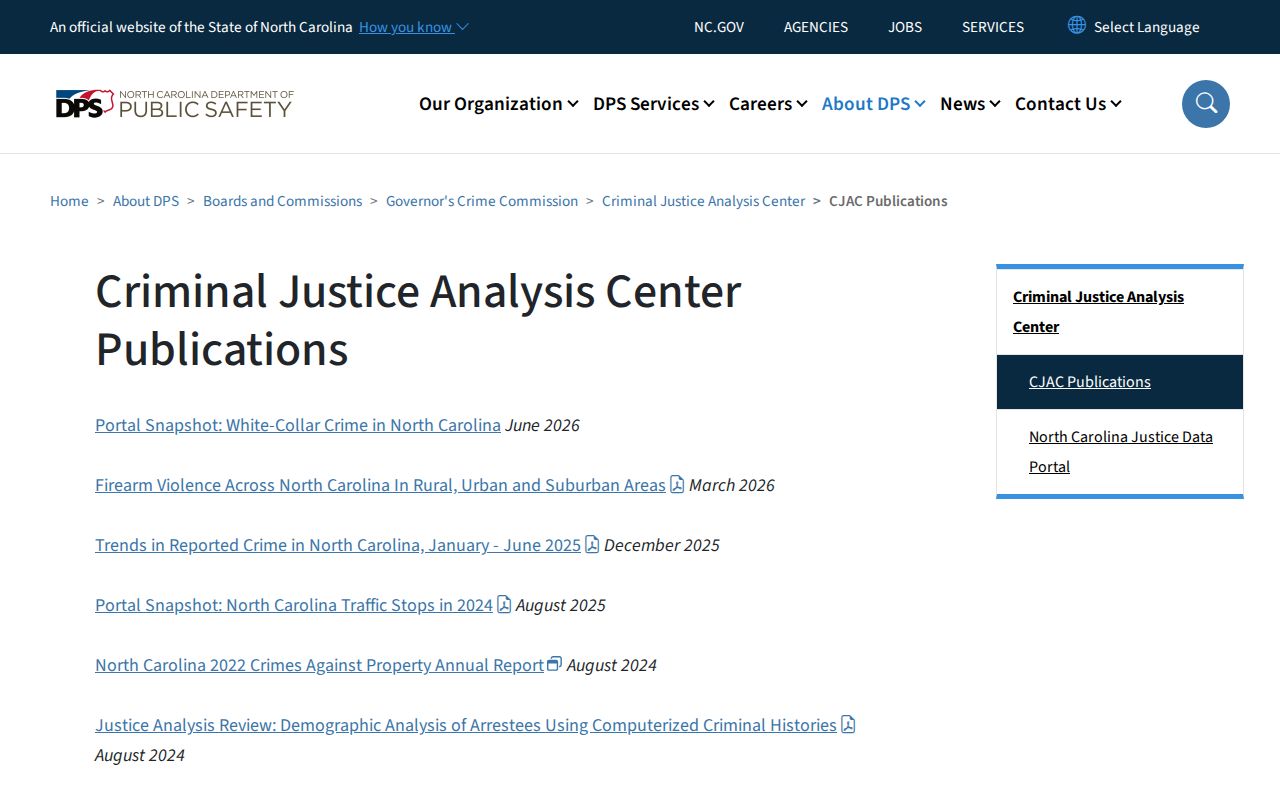
The Criminal Justice Analysis Center publication library adds dated statewide reports and methods behind the figures.
SBI’s 2024 Adult and Juvenile Arrest Summary counted 231,397 arrest events, including 220,992 adult and 10,405 juvenile events. Those totals are events, not necessarily unique people. They also do not measure convictions. A separate 2024 clearance report counted 249,848 index crimes and 37,192 clearances, but a clearance is still not a judgment of guilt.
When a Dismissed Arrest Remains
A dismissal does not always erase the arrest entry at once. North Carolina calls record clearing an expunction. G.S. 15A-146 schedules qualifying cases in which all charges ended in dismissal without leave, dismissal by the court, or not guilty or not responsible on or after December 1, 2021 for expunction by operation of law 180 to 210 days after final disposition. A felony dismissed through a plea agreement is excluded from that automatic path, and data matching can delay removal.
If an eligible arrest still appears, first obtain the charge disposition and signed order from the Clerk of Superior Court in the county of charge. Then request your NC SBI Right to Review. Send SBI a written exception with the arrest-cycle details and county proof if its fingerprint history remains wrong. Other grounds, including some older nonviolent convictions, have separate waiting periods and exclusions, so use the exact Judicial Branch form and statute rather than assuming a dismissal rule applies.
Arrests vs Convictions in North Carolina
A North Carolina arrest records an accusation and a custody or process event. A conviction records guilt established by a plea or verdict and entered in a court judgment. A person may have an arrest even when prosecutors file no charge or every charge ends in dismissal or acquittal. Search the county court case and read each count before describing the result.
| Arrest Record | Conviction Record | |
|---|---|---|
| Created by | Arresting agency and county jail | Court judgment, later reported to SBI |
| What it proves | An arrest or booking occurred | Guilt was entered by plea or verdict |
| Best source | County agency, jail, or personal SBI review | County clerk and public eCourts summary |
| Possible relief | Dismissal and other expunction paths may apply | Narrower offense-specific expunction rules apply |
Note: An arrest entry without a disposition is not proof of guilt; verify the county court outcome before drawing conclusions.