
What the North Carolina State Bureau of Investigation Is
The North Carolina State Bureau of Investigation Criminal Information and Identification Section is the central keeper of fingerprint-based Criminal History Record Information. It receives fingerprint cards from law-enforcement and prison systems, builds Computerized Criminal History entries, and links final court dispositions to arrest cycles. The file is identity centered. North Carolina eCourts, by contrast, is case centered and remains a Judicial Branch system.
NC SBI is a principal state department whose director reports to the Governor. It should not be described as a current unit of the Department of Justice or Department of Public Safety. CIIS includes fingerprint search, NICS/CCH maintenance, civilian services, access integrity, expunction, sex-offender coordination, compliance, crime reporting, and training functions. Its civilian services work supports more than 5,000 approved agencies, but that figure is not the number of people or rap sheets in the repository.
The official CIIS overview shows how these functions sit together.
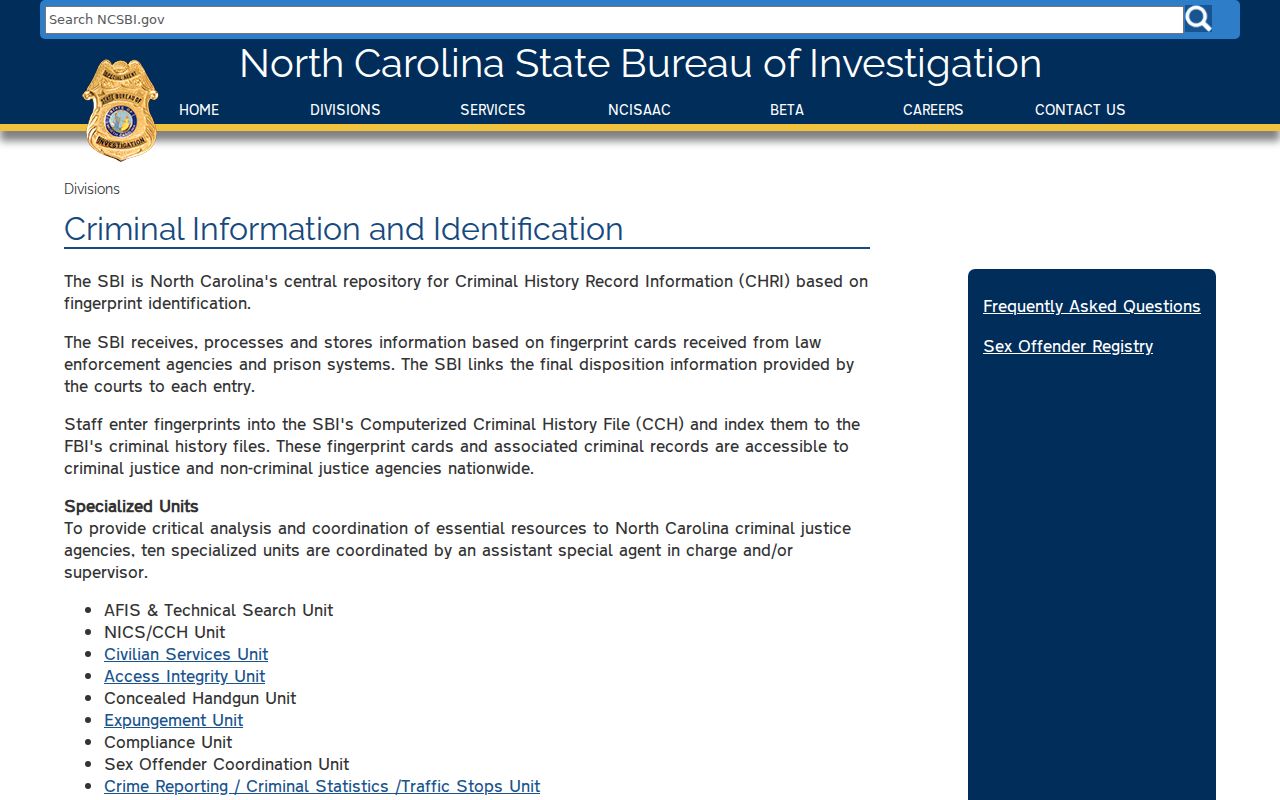
The agency profile confirms that fingerprints, disposition research, expunction processing, and record access are separate tasks within one statewide section.
NC SBI Fingerprint Milestones
North Carolina created the State Bureau of Identification and Investigation by 1937 law. Operations began in 1938 with identification, investigations, and criminal statistics units. The name changed to SBI in 1939. Its official history records later turning points: a Garner Road headquarters in 1976, the merger of the Police Information Network with SBI Identification in 1985, AFIS use beginning in 1986, and Rapid ID handheld fingerprinting in 2017.
Those milestones explain the current repository better than a single founding date. Paper arrest cards grew into CCH. Automated fingerprint matching made identity links more reliable. Live Scan sped local submissions. FBI indexing then connected eligible North Carolina records to national exchange. The repository still depends on the accuracy and timing of the local arrest, court, and corrections data sent into it.
Note: NC SBI publishes verified system milestones, but it does not publish a complete dated timeline for every technology change.
NC SBI Criminal History Check Options
NC SBI does not offer the public a pay-per-name conviction portal. Its direct public product is Right to Review, a mailed fingerprint search for the person whose record is requested. Statutorily authorized agencies use separate access agreements and may obtain name-based or state-and-national fingerprint results within their legal authority. Public court information comes from clerks, courthouse terminals, or eCourts, not from an SBI public name tool.
| Product | Who May Order | What It Returns | Cost |
|---|---|---|---|
| NC SBI Right to Review | The record subject by mail | North Carolina fingerprint-supported arrests and linked dispositions available in CCH | $14 per request or copy |
| Authorized state name check | An agency with statutory authority and an SBI Access Agreement | An authorized North Carolina name-based identification or CHRI response | $10 when applicable |
| State and national fingerprint check | A qualified agency with authority and an Access Agreement | North Carolina CCH plus an FBI fingerprint response | $38, plus possible capture fee |
| FBI Identity History Summary | The subject through the FBI | FBI-maintained identity-history entries or a no-record response | $18, plus possible capture or channeler fee |
Note: Authorized-agency products are limited by statute and agreement; they are not public alternatives to Right to Review.
NC SBI Right to Review
The form asks for a complete name, mailing address, race, sex, date of birth, signature, and request date. A Social Security number is voluntary. A legible ten-print card is required, subject to physical exceptions noted on the form. The card also carries aliases, descriptive details, the reason “Right to Review,” and the fingerprinting official's date and signature. Poor or incomplete impressions can be returned.
The result is a North Carolina state-only biometric search and an SBI response letter. It can show prior North Carolina arrests and associated dispositions only when SBI received a qualifying fingerprint card and matching disposition. It does not add an event maintained solely by another state or only by the FBI. A person unable to pay may ask for a waiver with proof of indigence, such as a notarized affidavit.
The NC SBI personal review page publishes the fee and delivery rules.
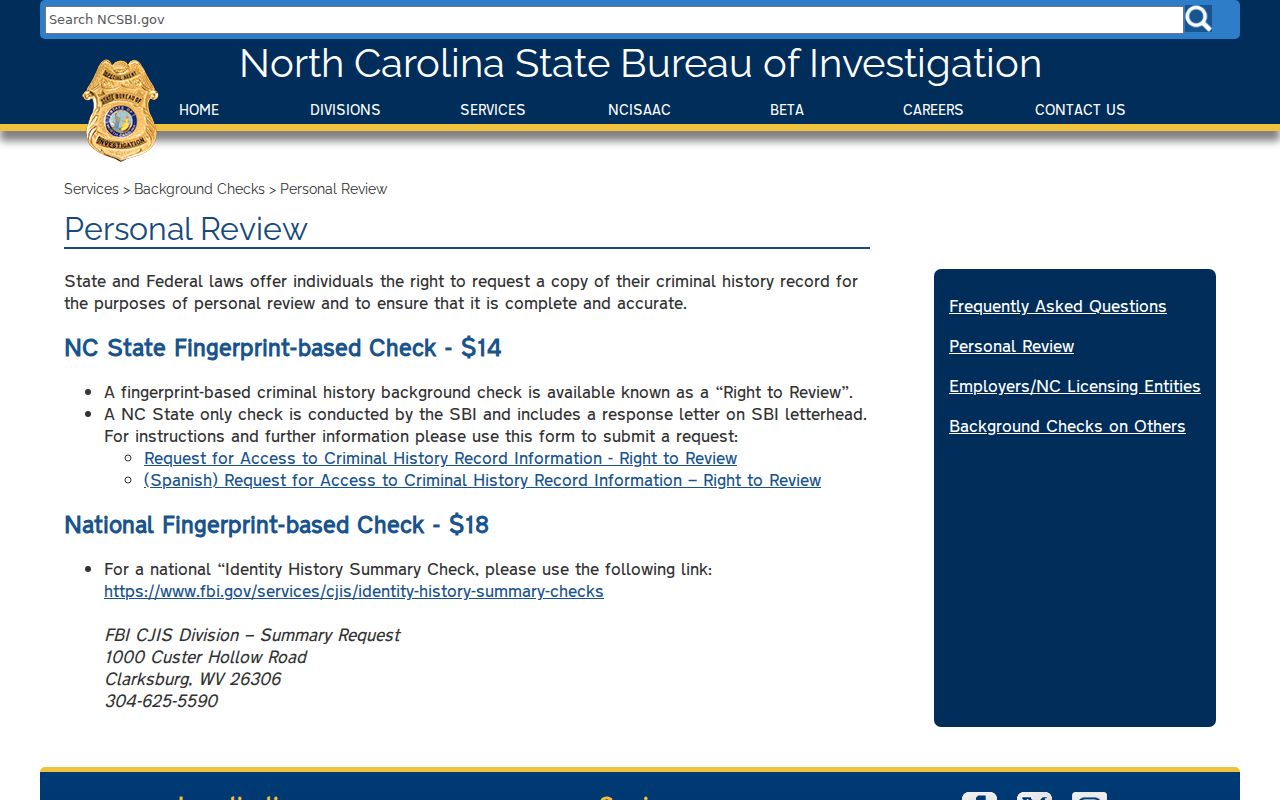
The official page also distinguishes the $14 state review from the separate $18 FBI route.
How Records Reach NC SBI
City police, county deputies, troopers, campus officers, and other authorized officers create arrest records. For covered arrests, the agency captures fingerprints and sends them to SBI through Live Scan or a card. NC SBI uses the biometric transaction to join aliases and later events to one identity. Court clerks then report final dispositions, while North Carolina corrections supplies custody segments following conviction and commitment.
Data flow: County Arrest › Fingerprint Submission › North Carolina State Bureau of Investigation › Court Disposition Reporting › Rap Sheet
The statutory timing matters. G.S. 15A-502 governs fingerprints for felonies and listed categories. G.S. 15A-1382 generally requires qualifying disposition reports within 60 days. Missing fingerprints, unmatched identifiers, an unreported outcome, or local-only data can still make the rap sheet differ from the original county file.
NC SBI Record Segments
The NC SBI training manual divides CCH into three working parts. The Arrest Data Segment comes from a North Carolina law-enforcement fingerprint card. The Court Disposition Segment comes from the Administrative Office of the Courts. The Custody Data Segment comes from corrections after a conviction and custodial sentence. Reading an entry by segment can reveal why one part is present while another is not.
- Arrest cycle
- A fingerprint-linked event with charge data submitted by the arresting agency.
- Disposition
- The court's outcome for a charge, such as dismissal, guilty judgment, or another final action.
- Rap sheet
- The compiled identity-centered history assembled from qualifying reported events.
- Case file
- The locally held docket and documents for one court matter.
None of these labels means the file is complete. NC SBI publishes no official public completeness rate or total CCH count. A county clerk's judgment remains the best source for the exact result in a case.
Note: A missing disposition often calls for county documentation, not a second name search in another public index.
Ordering a Check From NC SBI
A personal North Carolina record review uses local fingerprint capture and postal mail. NC SBI has not published a statewide private-vendor appointment network for this product. A 2025 law authorized approved vendors, but the current public instructions still reject third-party electronic submission for Right to Review. Confirm card service, identification, appointments, and local fees with a law-enforcement fingerprint unit.
- Choose the personal Right to Review route for your own North Carolina fingerprint-based history. Use the FBI route only when an FBI-maintained multi-jurisdiction summary is needed.
- Get an FD-258 ten-print card from a local law-enforcement fingerprint service. Check each identity field, impression, signature, and date before leaving.
- Complete the SBI form and mail the original card. NC SBI does not accept personal delivery, third-party electronic submission, or private carrier delivery for this request.
- Include a $14 certified check or money order payable to NC SBI. Cash, credit cards, personal checks, and business checks are not accepted.
- Allow up to 20 business days from receipt. Compare each entry with the relevant county court record before interpreting it.
Why NC SBI Uses Fingerprints
Names change and may be shared. Fingerprints help NC SBI associate an arrest with the correct identity and connect aliases to the same person. That makes Right to Review a better tool for confirming one's own state history than a name-only index. It does not make every local event appear. An unfingerprinted citation, a sealed matter, an expunction, or an event held only in a court system may be absent.
Fingerprint capture is only one point in the chain. The printed card must be legible, the arrest transaction must reach SBI, and the later court outcome must match the arrest identifiers. When a final result seems missing, the county judgment supplies the evidence needed for disposition research. A blank or partial SBI response should never be treated as proof that no local file exists.
Note: Fingerprints resolve identity more reliably than names, but they cannot add a local event that was never submitted.
County Records vs NC SBI Checks
NC SBI offers statewide identity-based scope. County offices hold the source records. A rap sheet summarizes reported arrest cycles and available outcomes, while a clerk file can contain warrants, hearing events, pleadings, judgments, and documents that never belong on a rap sheet. Recent booking and jail status stay with the sheriff or detention center. Use the North Carolina county directory to reach the local layer.
| Point | NC SBI Check | County Records |
|---|---|---|
| Coverage | Reported qualifying events statewide | Arrests and cases created in one county |
| Source | Fingerprint-centered compiled history | Original clerk, sheriff, jail, and police files |
| Timing | Depends on submission and matching | Changes as booking and the case move |
| Detail | Summary arrest, charge, disposition, and custody segments | Docket events, documents, certified judgments, and current custody facts |
| Best use | Reviewing one's own statewide biometric record | Verifying one event and obtaining official documents |
NC SBI Statutory Authority
G.S. 143B-1208.1 establishes the SBI and its criminal-identification role. G.S. 143B-1208.15 identifies SBI as the criminal-history repository and supports participation in national fingerprint exchange. These laws define a state information role, not custody of every criminal document.
The distinction also explains why North Carolina eCourts does not replace SBI. Portal searches public case information by name or case number. Right to Review searches the subject's fingerprints against the repository. Both may be needed to understand why a court outcome displays differently from a statewide criminal history entry.
Note: Court access law and SBI dissemination authority apply to different records, even when both describe the same event.
Fixing Errors in an NC SBI Record
Start with Right to Review so the challenged file is tied to fingerprints. Common problems include a missing disposition, a wrong identity link, a charge that should reflect a later outcome, or data that should have been removed after an expunction order. NC SBI calls the formal challenge a Written Exception. CIIS audits its entry and can coordinate with the agency that supplied the data.
- Order your own NC SBI record and mark the exact arrest cycle, charge, or disposition that appears wrong or incomplete.
- Obtain a certified judgment, dismissal, expunction order, or contributing-agency record from the county that created the source event.
- Send the Written Exception and proof to the NICS/CCH Unit Supervisor. State the requested correction and keep copies of the full packet.
- Review the written outcome and order a fresh copy when appropriate. Check the county file and FBI summary separately because each system is maintained on its own.
If an incorrect North Carolina entry also reached the FBI, correct it at the contributing state source and use the FBI challenge channel as needed. An FBI correction does not grant a North Carolina expunction. Expunction relief begins with the court that has authority over the record.
NC SBI CIIS Contact
CIIS Customer Service answers repository questions at 919-582-8660 or CIIShelp@ncsbi.gov. Right to Review requests go to Applicant Unit, Right to Review, 3320 Garner Road, Raleigh, NC 27610. The challenge route may use NICS/CCH Unit Supervisor, NCSBI-CIIS, P.O. Box 29500, Raleigh, NC 27626-0500.
NC SBI CIIS
3320 Garner Road
Raleigh, NC 27610
919-582-8660
Contact the county clerk for certified case documents and the arresting agency for its original report. NC SBI can correct the statewide repository, but it cannot rewrite a source document held by another custodian.