
Criminal Court Cases in North Carolina
North Carolina uses the General Court of Justice across the state. Magistrates issue process, conduct initial appearances, and set release conditions within their authority. District Court hears misdemeanors and infractions. It also handles early felony steps, including probable-cause matters. Superior Court is the main felony trial court and hears misdemeanor appeals for a new trial. The Court of Appeals and Supreme Court review eligible lower-court decisions rather than retrying the original facts.
The elected Clerk of Superior Court keeps both District and Superior Court case records for the filing county. That local custody matters even though the courts use a shared electronic platform. A public portal can index North Carolina criminal cases statewide, but it does not turn the administrative office or the NC SBI into the custodian of motions, orders, exhibits, and certified judgments.
North Carolina Court Levels Compared
The court name signals where a North Carolina criminal case stands. A felony often begins with District Court events before an indictment places it in Superior Court. A misdemeanor usually remains in District Court, but a conviction may be appealed to Superior Court for trial de novo. That means a new trial, not a standard review limited to the first record.
| Court | Criminal role | Next route |
|---|---|---|
| Magistrate | Process, initial appearance, bond, and minor matters | District or Superior process |
| District Court | Misdemeanors, infractions, and early felony matters | Superior Court or other review set by law |
| Superior Court | Felony trials and misdemeanor appeals de novo | State appellate courts |
| Appellate courts | Review of appealable rulings and judgments | Supreme Court review where allowed |
Read the court division along with the charge and event history. A District Court felony entry does not mean the felony trial belongs there. It may show only the case's preliminary path toward Superior Court.
Note: A District Court misdemeanor appeal creates a new Superior Court trial, so both North Carolina court entries may matter.
Searching North Carolina eCourts Portal
North Carolina eCourts Portal offers anonymous public access without registration. A free account can save matters to “My Cases,” but it does not unlock sealed or restricted content. The Portal landing screen below shows the separate search paths available to the public.
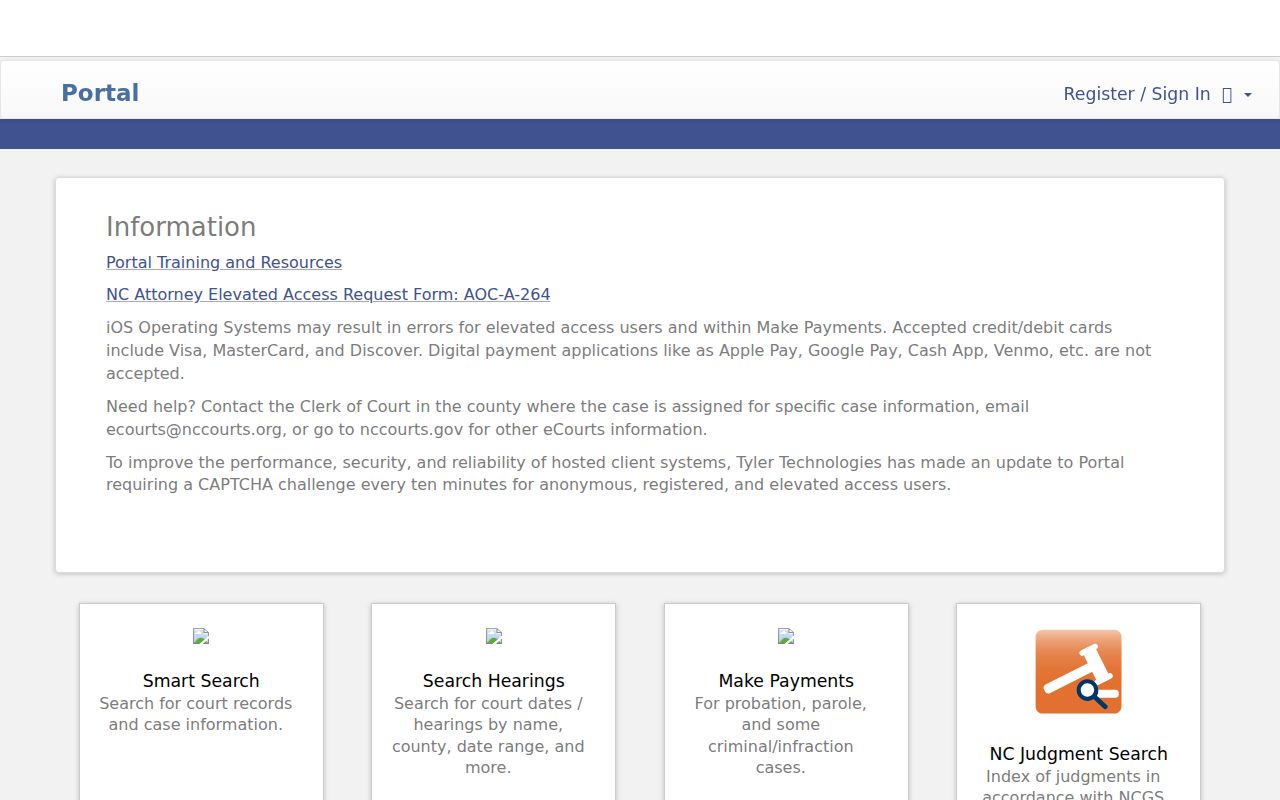
Choose the search path that matches the question. Smart Search locates a case, Hearing Search finds scheduled events, and Judgment Search helps cross-check results.
- Open Smart Search and enter a full or properly wildcarded party name or case number.
- Use Advanced Filtering Options to choose Criminal Actions, case type, status, filing dates, and location.
- Open the result whose county, party, and case number match. Do not rely on name alone.
- Read each charge and its disposition, then check hearings, events, judgment, sentence, and financial entries.
- Ask the filing county's Clerk of Superior Court for documents or certification when the summary is not enough.
| Field or filter | Type | Required | North Carolina search note |
|---|---|---|---|
| Case Number | Text | Alternative | Use four or more characters plus * for a partial number. |
| Party / Business Name | Text | Alternative | Last name needs three characters plus *; first name needs one plus *. |
| Location | Dropdown | No | Narrows the search to a court location or county. |
| Case Category / Type | Multiselect | No | Select Criminal Actions, then narrow the case type. |
| Status and Filing Dates | Dropdown / dates | No | Narrows active or disposed cases and the filing period. |
| Hearing Criteria | Text / dropdowns | One criterion | Search by case, party, attorney, judge, or courtroom. |
The official Portal training and search guidance illustrates the wildcard rules and advanced filters shown below.
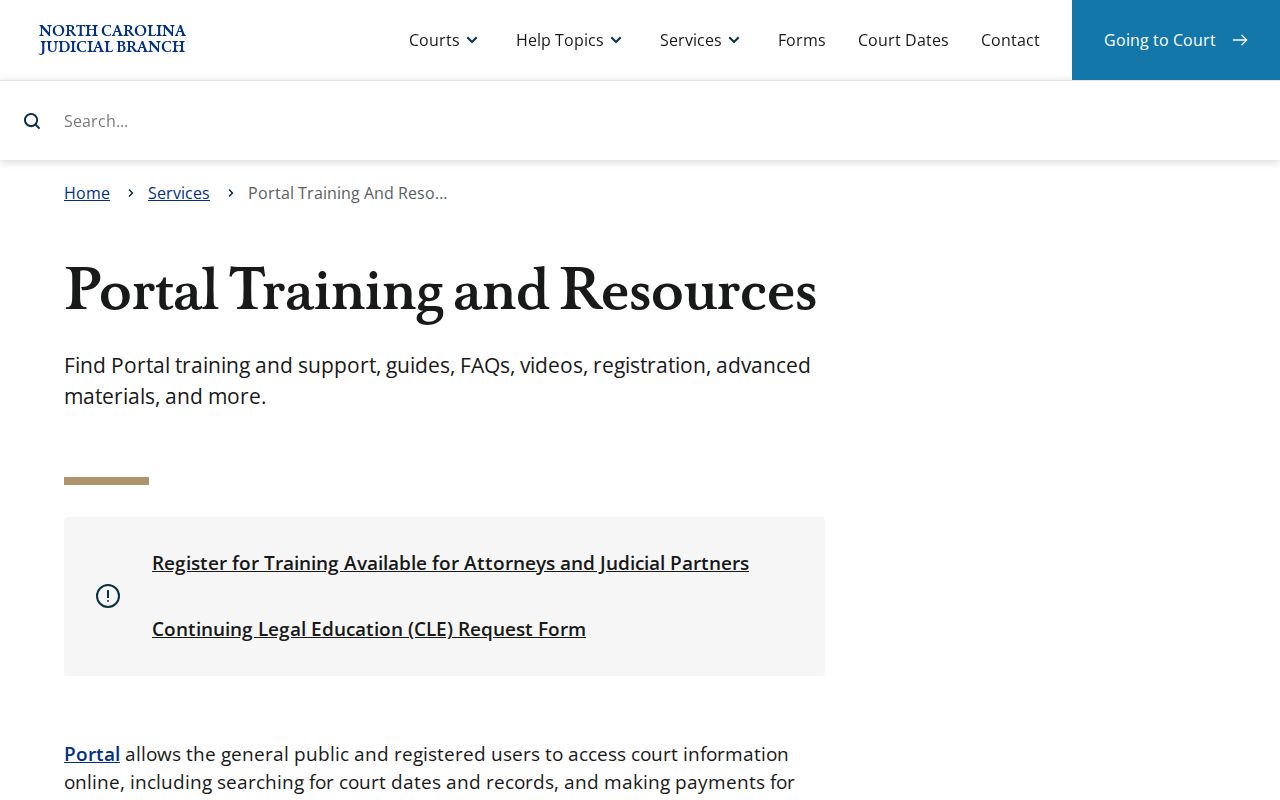
Those rules are useful when spelling, spacing, or a partial case number keeps an otherwise public North Carolina case out of a broad result list.
North Carolina Portal and Clerk Files
All 100 North Carolina counties have used Enterprise Justice since October 13, 2025. Historical records were migrated, but that does not create one guaranteed starting year for every matter. Correction indexes, archived paper, microfilm, and documents not offered as free downloads can remain outside the public summary. The filing county's clerk is still the right contact for an old or missing case.
The Judicial Branch's statewide eCourts rollout record documents that completed coverage, as reflected in the implementation notice below.
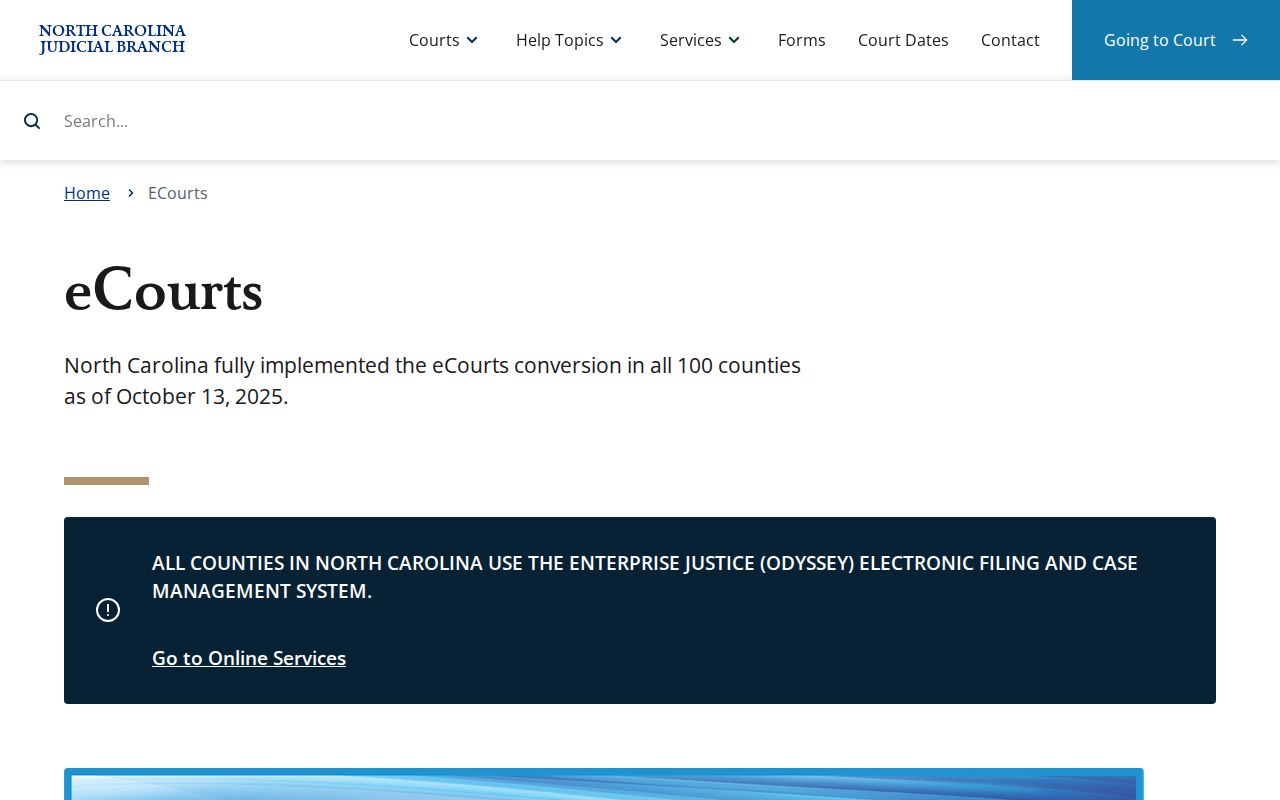
Statewide coverage makes case discovery easier. It does not replace the county court file, nor does it make every document public or downloadable.
Inside a North Carolina Criminal Case File
A North Carolina criminal case summary joins identification, charge, schedule, event, outcome, and money fields. Yet “case status” is only a high-level label. One case can contain several counts with different results. Open each charge line and read the register of actions before deciding what happened.
| Case Number & Court | Enterprise Justice number, filing county, court division, case type, filing date, status, and judicial assignment. |
|---|---|
| Parties & Attorneys | Public party names, roles, and counsel, with protected identifiers omitted or limited. |
| Charges | Description, statute or offense code, class, count sequence, charge status, and charge-level disposition. |
| Docket Events | Process, appearances, indictment, motions, settings, continuances, pleas, verdicts, orders, and appeal notices. |
| Hearings | Date, time, courtroom, hearing type, judicial officer, and entered result when public. |
| Judgment & Sentence | Outcome, sentence, probation or confinement, restitution, costs, fines, payments, and balances when applicable. |
Portal financial tools accept certain costs, restitution, attorney fees, and probation or parole fees. They do not accept cash bonds or bond forfeitures. Full dates of birth, Social Security numbers, protected addresses, victim or minor details, sealed documents, and juvenile matters are not ordinary public fields.
Note: A public North Carolina case summary may omit filed documents that remain available from the county clerk.
Decode North Carolina Criminal Case Numbers
An Enterprise Justice case number combines a two-digit year, case-type letters, a six-digit sequence, and a three-digit county code. The format may look like 21CR000003-910. It is a court identifier. It is not an NC SBI state identification number, county booking number, or NCDAC offender number.
- CR
- A District Court criminal case designation.
- CRS
- A Superior Court criminal case designation.
- FTA
- Failure to appear.
- OFA
- Order for arrest, often tied to nonappearance or noncompliance.
- PJ
- Prayer for Judgment Continued, a distinct North Carolina result that should not be guessed from the case status alone.
The official AOC-CR-314 court code key defines more plea, disposition, process, and sentence abbreviations. Codes such as VD, VL, NB, NP, GA, GU, and NG describe different acts or outcomes. They are not interchangeable.
How a North Carolina Criminal Case Moves
An arrest, citation, warrant, summons, or magistrate order can start the public trail. An initial appearance addresses identity, charges, counsel, and release. Misdemeanors proceed in District Court. A felony normally has early District Court events before indictment or another lawful charging route carries it to Superior Court. Motions, discovery, settings, and continuances add docket entries but do not decide guilt.
Case flow: Charges Filed › Arraignment › Pretrial › Plea or Trial › Disposition › Sentencing
A plea or trial produces charge-level results. Judgment can record active, intermediate, or community punishment, plus probation, restitution, costs, and appeal notice. Later violations, orders for arrest, sentence changes, expunction petitions, or appellate mandates can add events long after the first judgment.
North Carolina Case Status vs Disposition
A pending or disposed case label cannot answer what happened to every charge. A single North Carolina criminal case may show one conviction, another dismissal, and a reduced count. Read the result beside each charge, the plea or verdict basis, and the disposition date. Then compare the judgment and sentence entries.
A dismissal also has forms. “DC” means dismissed by a judge. “VD” means voluntary dismissal without leave, while “VL” means dismissal with leave. “NB” is no true bill, and “NP” is no probable cause. An acquittal, dismissal, deferred matter, and conviction carry different meanings. None should be inferred from an arrest or the fact that a docket exists.
Note: Registration can save cases, but it never grants elevated access to sealed, juvenile, or otherwise restricted North Carolina court records.
North Carolina Cases and SBI Records
The county court file is not a rap sheet. The NC SBI computerized criminal history is fingerprint based. It links qualifying arrest cycles to available court dispositions reported back to the repository. A county file holds the case's fuller event trail and documents. Missing fingerprints, delayed disposition reporting, mismatched charge identifiers, or court-only records can make the two products differ.
G.S. 15A-1382 requires transmission of specified disposition information, but the linked SBI entry is still not a substitute for the judgment. For self-review of the fingerprint history, use the NC SBI Right to Review. For motions, orders, and certified outcomes, use the county clerk.
Case Records at the County Level
Start with Portal, then route document questions to the Clerk of Superior Court where the North Carolina criminal case was filed. Any courthouse public terminal can run a free statewide, noncertified search and may email results. A certified clerk criminal record search costs $25 and covers one county. It is name based, so aliases and people with similar names can affect the result.
For paper or electronic copies, certification, archived files, or a matter missing online, contact that filing county. Police reports belong to the investigating agency. Booking records belong to the county jail. Neither is part of the clerk's full case file or the SBI rap sheet. Browse the directory of all 100 North Carolina counties to reach the correct local route.
Note: Verify identity, every charge disposition, and the final judgment with the originating North Carolina clerk before relying on a case summary.